SOULAS JÉRÔME
Frontend & Fullstack Engineer · Platform & Architecture





Building in 2026 — A Personal Ecosystem
Beyond the day job, I build an ambitious, interconnected set of systems for the love of it — where I own every architectural call. Here's the shape of it.
SuperPlex
SuperPlex started as a simple itch — I want a custom "super" Netflix for my house — and turned into the most happily over-engineered thing I've built. Not just films and series, but live TV on every screen in the house, music, photos, ebooks and manga: every kind of media, one coherent experience, fully self-hosted.
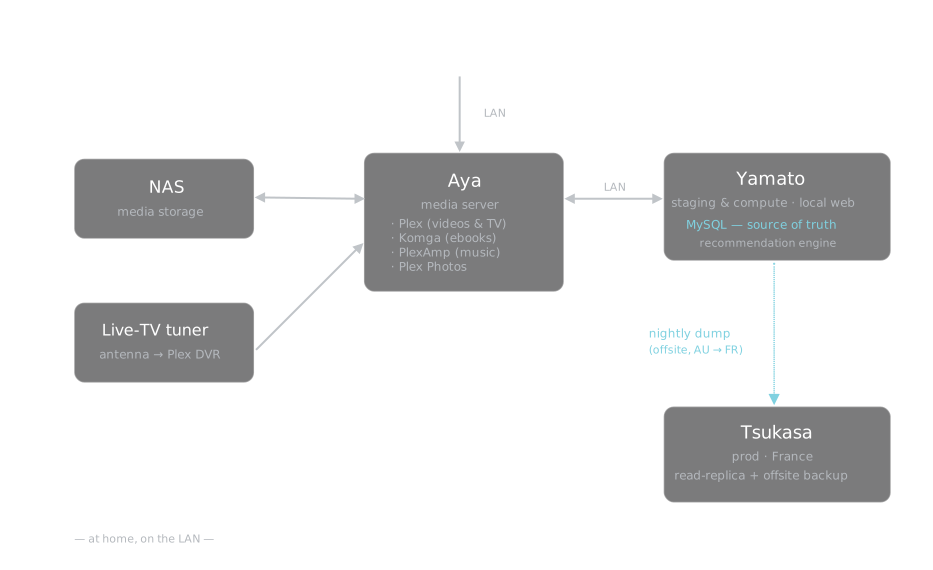
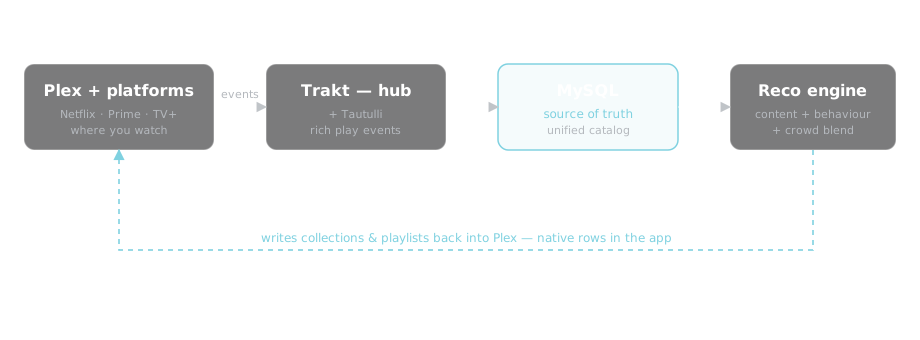
The interesting part isn't the playback — it's the platform I designed around it. A custom recommendation engine fed by my own source-of-truth database; watch history unified across every service I use, not just my own server, through a single hub; a legacy cataloguing app of mine folded into the same schema. It runs across a few single-purpose machines with an offsite replica in France for backup — and I designed the whole topology, data flow and failure modes end to end, on paper, before writing a line of build code.
And I designed it for the failure modes, not just the happy path — every backup path has a freshness check, because silence shouldn't read as success. The same way I'd architect a platform at work, just for the love of it.
Shani Studios
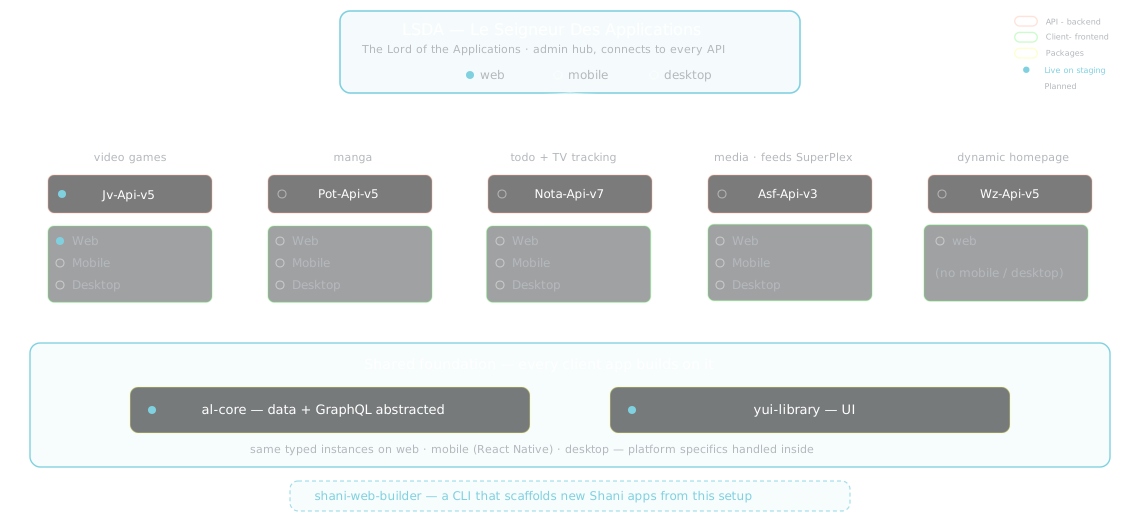
Shani is the long game: a decade of personal apps I built from 2009 and maintained until 2014 (and still using) — collections for games, manga and media, a TV-tracker-slash-todo, a custom dynamic browser homepage — all still running on the PHP/MySQL I never came back to. The plan is to drag every one of them into the present: not just a modern rebuild, but a full suite — web, mobile and desktop — for each.
What makes it a system and not a pile of rewrites is the shape. Every project shares two libraries of mine: al-core, which turns each API's entities into typed class instances and hides all the GraphQL behind plain method calls — the same instances whatever the platform, web, mobile or desktop, with the platform-specific bits (storage and the like) handled inside — and yui-library for the UI, with its web and React Native equivalents. Because al-core is reusable, one client can talk to everything. That's the keystone: LSDA — Le Seigneur Des Applications (The Lord of the Applications) — a single admin app that connects to every API in the nebula and runs the whole thing from one place, instead of a dozen scattered back-offices.
It is around 21 apps across six projects, all leaning on those same two libraries — desktop builds reuse the web (Svelte + Tauri), mobile is React Native, and al-core and yui hold it together across all three. Most of it is still ahead of me — three apps and the libraries are live on staging so far — but the architecture is set. It is the clearest picture of how I think about platforms: build the foundation once, then ship features cheaply on top — I even built a small bootstrap tool that scaffolds a new app in the ecosystem from the canonical setup, shared libraries and all.